
Maritime AI: How Artificial Intelligence Is Changing Fleet Management
Maritime AI is becoming one of the most important topics in shipping, offshore operations, port logistics and technical fleet management. But the real value of AI in maritime is often misunderstood.
The future is not simply a chatbot answering generic maritime questions. The real opportunity is AI connected to vessel operations, maintenance history, equipment data, procurement, compliance and fleet performance.
That is where maritime AI becomes operationally useful.
Where Maritime AI Is Already Emerging
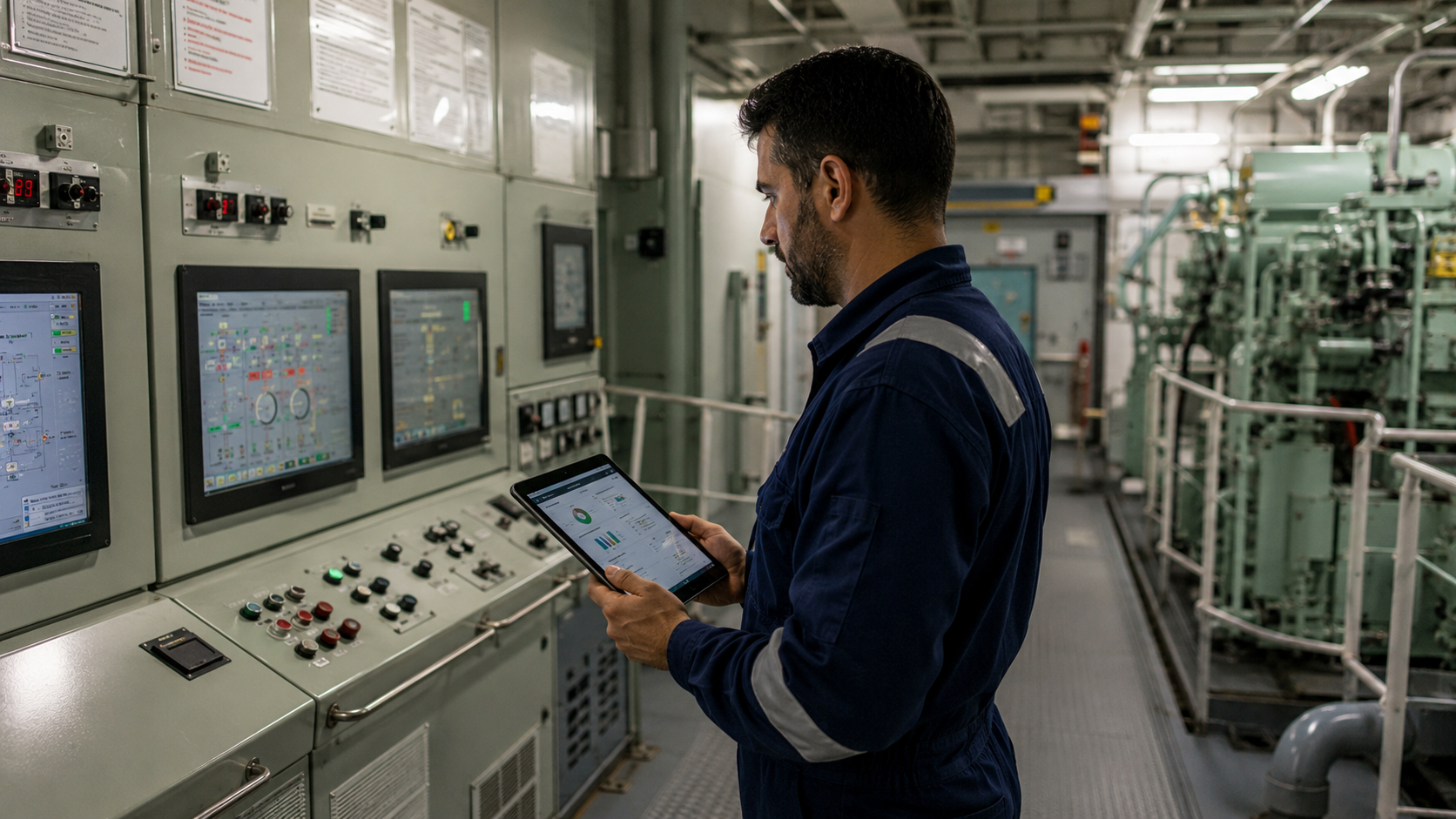
AI is increasingly being discussed across vessel design, construction, intelligent automation, autonomous ships and maritime operations. Lloyd’s Register describes AI as a transformational technology beginning to affect maritime activities across the board.
In practical fleet operations, maritime AI can support:
predictive maintenance
equipment health monitoring
technical superintendent decision support
procurement analysis
document and report generation
voyage and route optimization
compliance workflows
anomaly detection
risk prioritization
fleet-wide operational search
Reuters also reported that AI-supported navigation and voyage optimization could reduce route deviations, fuel use and emissions, with one cited study estimating substantial annual emissions-reduction potential from AI-assisted navigation.
The Problem with Generic Maritime AI
Many AI tools are useful for general information, but maritime operations require more than general answers.
A technical superintendent does not only need to know what a planned maintenance system is. They need to know:
which vessel has critical overdue tasks
which equipment has recurring defects
which maintenance history is incomplete
whether parts are available
whether a work done report was submitted
whether procurement should be prepared
whether an AI recommendation is safe to approve
This requires AI to be grounded in structured fleet data.
AI Must Be Connected to the Fleet
The best maritime AI systems will not operate in isolation. They will connect to:
vessel databases
PMS schedules
equipment installations
running-hour logs
events and defects
work done reports
spare-parts inventory
supplier and procurement records
compliance documents
historical maintenance patterns
This is the difference between an AI chatbot and an AI fleet intelligence agent.
A chatbot answers text.
A fleet intelligence agent understands operational context.
Fleetcore’s Approach to Maritime AI
Fleetcore’s AI layer is designed around maritime operations, not generic conversation. The platform includes a specialized AI agent gateway with deterministic routing, domain-specific handlers, structured fleet-data queries, session memory and human-governed action proposals.
This allows users to ask questions like:
“Which vessels have critical overdue PMS tasks this week?”
“Which equipment has unresolved events?”
“Which parts are below reorder level?”
“Which maintenance tasks are linked to recent defects?”
“Which procurement offers are best based on price and lead time?”
The goal is not to remove humans from maritime operations. The goal is to reduce the cognitive load on fleet teams and help them act earlier.
Maritime AI Needs Governance
The maritime industry cannot adopt AI without safety, security and accountability. BIMCO highlights that digitalization creates cyber risks across shipping, including ransomware, phishing, spoofing and attacks on operational technology and navigation systems.
That is why maritime AI must be governed.
Fleetcore’s architecture is based on human-in-the-loop workflows. AI and ML can prepare recommendations, draft actions and surface risks, but critical operational changes require human review and approval.
Conclusion
Maritime AI will not replace technical teams. It will make the best teams faster, more informed and more consistent.
The winning systems will be those that combine AI with real fleet data, operational workflows, safety boundaries and human accountability.
That is the future of maritime AI: not generic automation, but intelligent, auditable decision support for fleet operations.